

HarvardMUN Canada 2027 Committees ProgramSince wars begin in the minds of men and women, it is in the minds of men and women that the defences of peace must be constructed.
UNITED NATIONS EDUCATIONAL,
SCIENTIFIC AND CULTURAL ORGANIZATION
UNESCOGeneral Assembly
The Upholding of Heritage, Education, and Science
The United Nations Educational, Scientific and Cultural Organization (UNESCO) is the UN's specialized agency for education, science, culture and communication; founded in 1945 and headquartered in Paris, it was built on the conviction that lasting peace depends on the intellectual and moral solidarity of humanity. Its member states meet every two years at the General Conference to set its programme and budget, while its best-known work, from the World Heritage List to global education standards, shapes how nations protect their past and prepare their next generation. Its mandate reaches into classrooms, laboratories, newsrooms and heritage sites alike: ensuring quality education for all; safeguarding cultural and natural heritage; advancing open and inclusive science; and defending freedom of expression.
You can contact the dais at unesco@hmuncanada.org for topic and committee-related inquiries, position paper extension requests and submissions, and conflict-of-interest concerns.
TOPIC ALoss of Native Language
Addressing the disappearance of Indigenous languages due to declining economic opportunities, limited educational support, and inadequate media representation.
TOPIC BRepatriation of Antiquities
Establishing ethical, legally binding mechanisms to return cultural artifacts acquired through colonial exploitation, theft, or coercion.
Committee Resources
To support your preparations, please refer to our resources. Review of the Rules of Procedure and the conference's academic policies is mandatory for all delegates. As the Rules of Procedure may be amended ahead of the conference, delegates are advised to consult our website periodically for the most recent version. Our staff are eager to see the case notes and research binders delegates bring to Toronto.
Globalization and the dominant status of a few widely spoken languages have led to the steady decline of Indigenous and other native languages across the world. This is exacerbated by diminishing economic opportunity, insufficient education, and a lack of media representation. In this topic, delegates will draft plans aimed at effectively preserving or revitalizing declining languages and promoting global linguistic diversity.
A lasting impact of colonialism involves the looting and extortion of large quantities of cultural objects, leaving them in foreign museums and private collections far from their countries of origin. While reconciliation efforts are slowly being introduced, the discussion of artifact return continues to suffer from disagreements concerning ownership, jurisdiction over legal matters, and the ability to preserve cultural artifacts. In this topic, delegates are to create plans with the goals of streamlining artifact return and improving reconciliation efforts with regard to cultural artifacts.
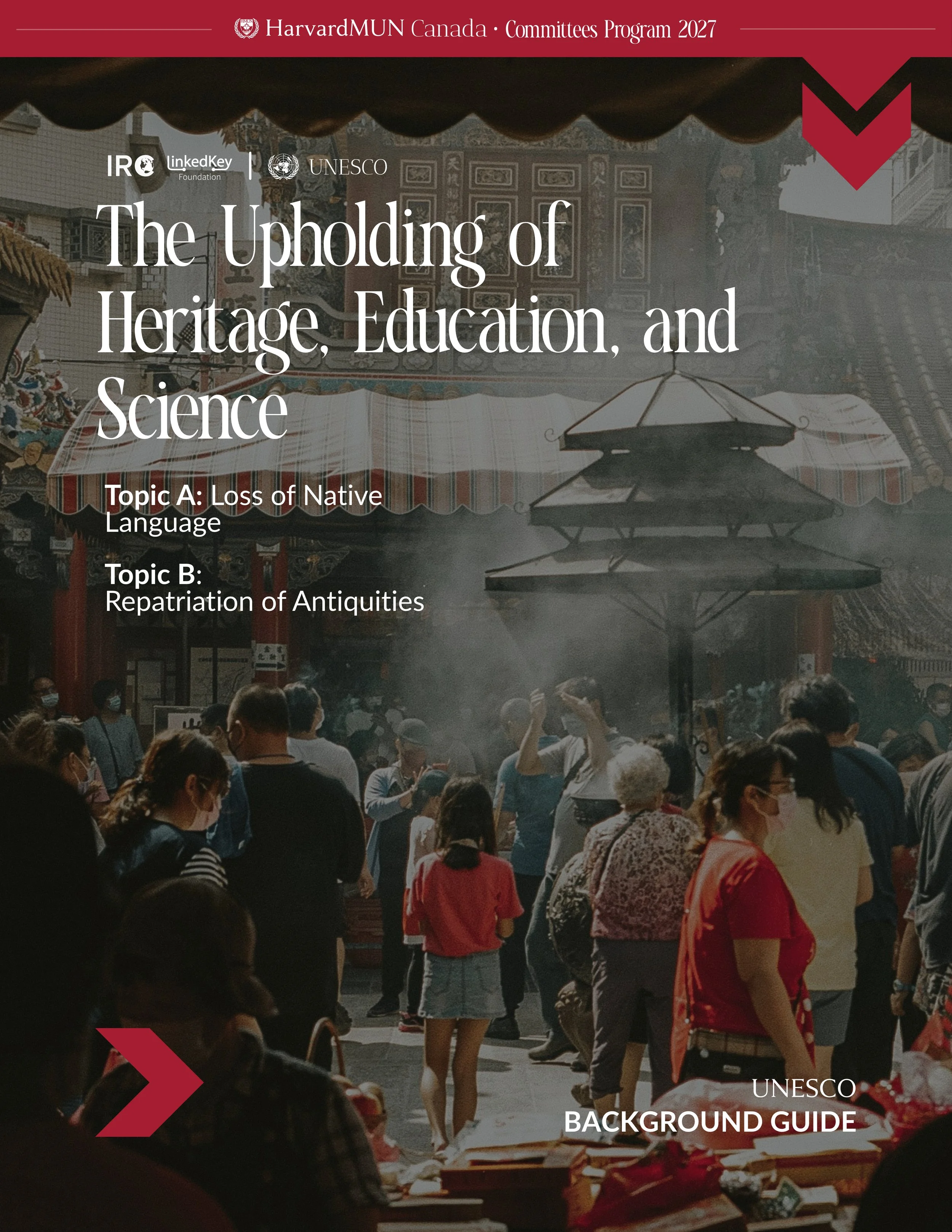
Background Guide (coming soon)
More delegate resources are in the works…