
The Land Down Under is Rising Up: The United States of America identifies Australia as a potential partner to provide relief aid in Ukraine.
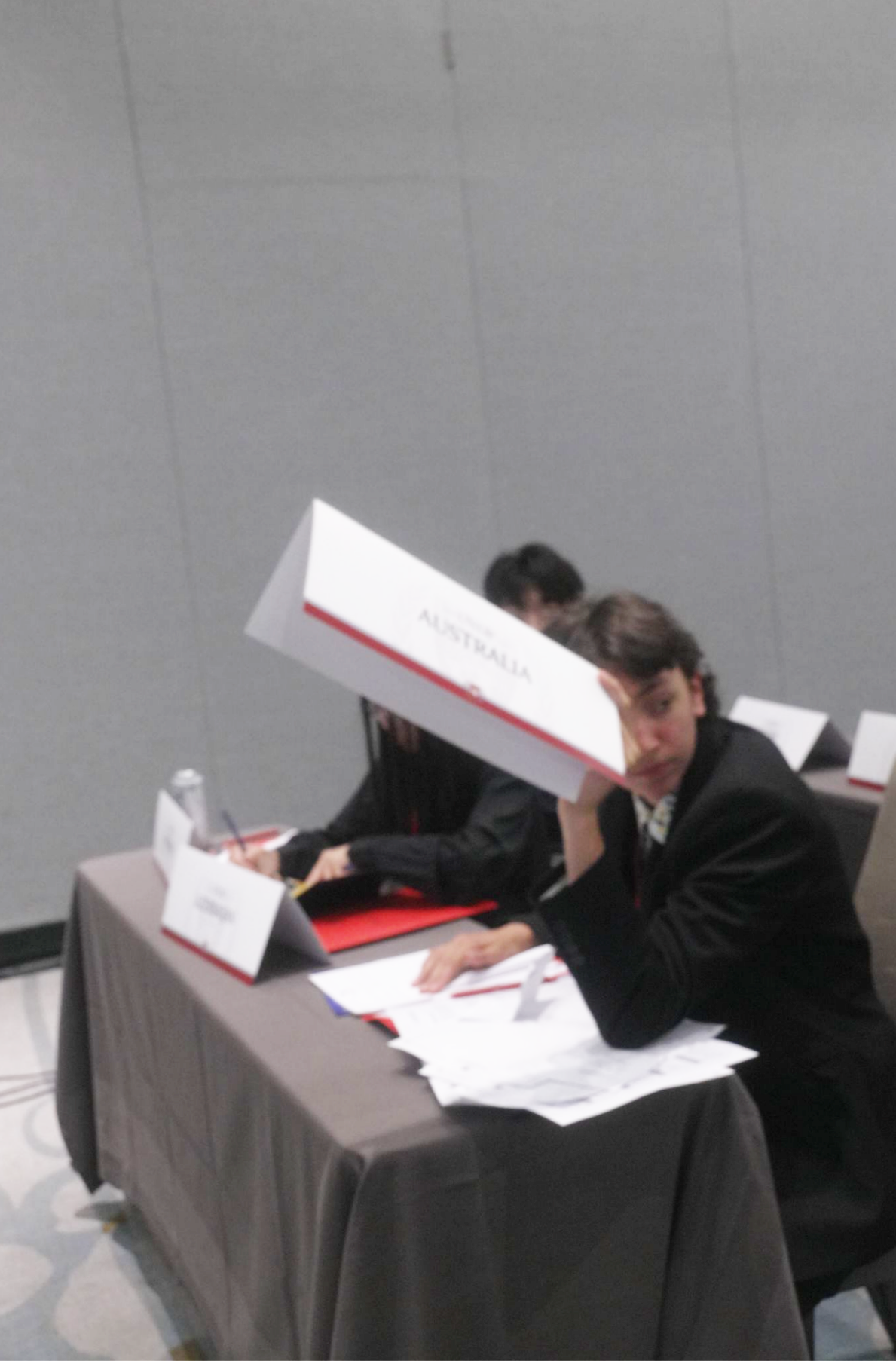
The Delegate of Australia raises placard to participate in debate of Ukrainian relief aid.
Following a personal interview in the United Nations Development Programme (UNDP), the Delegate of the United States recognized Australia as a potential partner to work with to provide relief aid in Ukraine.
The Australian Associated Press had an opportunity to interview the Delegate of the United States of America about the situation in Ukraine.
Question: Is Australia a country the United States of America is willing to work with?
“Seeing as if any delegate or any country wishes to help Ukraine better themselves and go towards a brighter future for Ukraine, the United States is 100-percent willing to work with them,” said the Delegate of the United States after questioned about the similarities of the stance the United States and Australia has on the situation in Ukraine (Delegate of the United States).
The Russo-Ukrainian conflict has been ongoing for more than 4 years at this point of time. Though the conflict is regional and directly affects the countries of Ukraine and Russia, the conflict shows influence through indirect manners.
The Australian Associated Press was able to obtain an interview with the Delegate of Ukraine, clarifying how the impact of the Russo-Ukrainian conflict extends upon the region of Ukraine.
Question: Although the Russia-Ukrainian conflict is a regional and national conflict, how does it impact the world globally?
“Sunflower oil disrupted international trade dropping by 1.3% and disrupted a lot of global food changes so because of this the global market can be impacted by this conflict because we don’t have any more agriculture, we can’t export any more… supply and demand” (Yau).
Since Russia’s conflict with Ukraine in early 2022, the Australian government has contributed $1.7 Billion AUD to the conflict, focusing on energy security, recovery and reconstruction, and restricting exports to Russia (Australian Government).
The ongoing conflict in Ukraine has disrupted nitrogen supply which led to unaffordable fertilizer for farmers, impacting the Australia agricultural industry (Reserve Bank of Australia). Additionally, wheat and barley prices have increased by nearly 30 percent since the conflict (Reserve Bank of Australia). The supplies of minerals such as aluminum, nickel, and iron have been impacted by the conflict, with iron ore prices seeing a 20 percent increase (Reserve Bank of Australia).
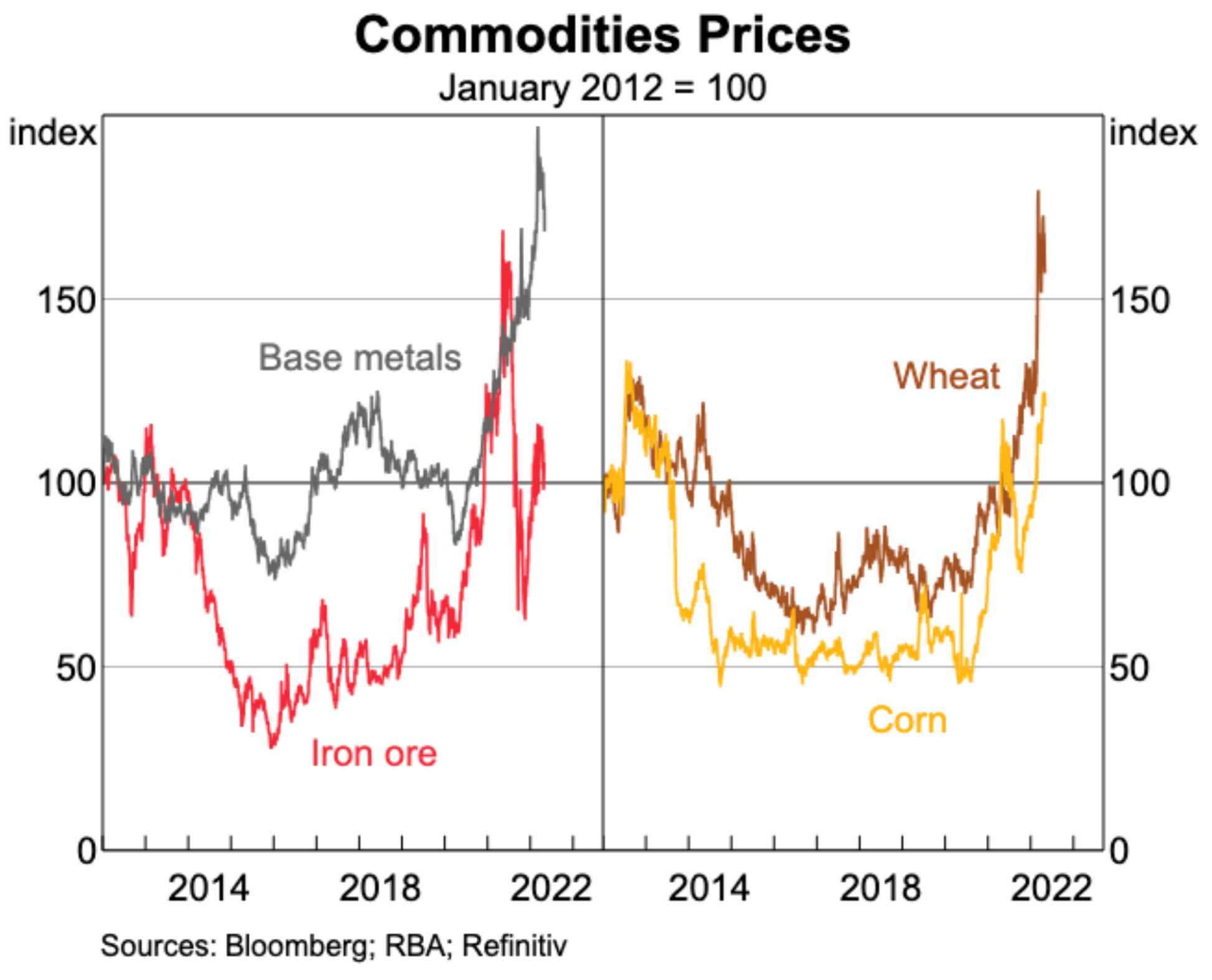
Commodities prices of Ukrainian goods (Reserve Bank of Australia).
As a country focused on transitioning to cleaner energy, the ongoing conflict in Ukraine creates new obstacles that Australian officials will have to manage.
Materials are not the only concern Australians have regarding the conflict. Australia houses around 38,000 Ukrainians, with most immigrating after the Ukrainian independence in 1991 (New South Wales Government). There have been around 15,000 Ukrainians living in New South Wales since 2021, with roughly 2000 new arrivals in 2021 (New South Wales Government).
As of now, roughly 17,000 people live in New South Wales — the most populous state of Australia with Ukrainian ancestry.
This group of Ukrainians will likely experience post-traumatic stress disorder (PTSD), substance abuse with substances such as alcohol, and anxiety and depression (New South Wales Government). Ukrainians tend to avoid seeking mental health help, focusing on survival rather than a lack of need (Asanov et al.). The unwillingness to seek mental health help will only hurt more Australia-Ukranians in the long term, especially since the Ukrainian population in Australia is only slightly above 30,000 people where help for Australia-Ukrainians would be less accessible (Encyclopedia of Ukraine).
Australia has recognized the implications of the war in Ukraine and identifies itself as a country willing to take initiative to combat the conflict. Though it is paramount for Australia to recognize Ukrainians within the nation itself, not just abroad.
Works Cited
Asanov, Anastasiya-Mariya, et al. “Mental Health and Stress Level of Ukrainians Seeking Psychological Help Online.” Heliyon, vol. 9, no. 11, 1 Nov. 2023, p. e21933, pubmed.ncbi.nlm.nih.gov/38027618/#:~:text=Refugees%20and%20internally%20displaced%20participants, https://doi.org/10.1016/j.heliyon.2023.e21933.
Australian Government. “Ukraine Country Brief.” Australian Government Department of Foreign Affairs and Trade, 2021, www.dfat.gov.au/geo/ukraine/ukraine-country-brief.
Delegate of the United States. United States and Supporting Ukraine. 29 May 2026.
Encyclopedia of Ukraine. “Australia.” Encyclopediaofukraine.com, 2021, www.encyclopediaofukraine.com/display.asp?linkpath=pages%5CA%5CU%5CAustralia.htm. Accessed 29 May 2026.
New South Wales Government. “Supporting Communities Impacted by the Invasion of Ukraine.” NSW Government, 10 Feb. 2026, www.nsw.gov.au/departments-and-agencies/transcultural-mental-health-centre/research-planning-evidence/community-population-mental-health-profiles/supporting-communities-impacted-by-invasion-of-ukraine. Accessed 29 May 2026.
Reserve Bank of Australia. “The International Environment | Statement on Monetary Policy – May 2022.” Reserve Bank of Australia, 6 May 2022, www.rba.gov.au/publications/smp/2022/may/the-international-environment.html.
Yau, Kate . Large-Scale Impact of the Russo-Ukrainian War. 29 May 2026.